 Brillius
Artificial Intelligence is changing the way people work.
It is helping professionals write faster, summarize information, analyze data, automate repetitive tasks, improve productivity, and make better decisions.
But this change also brings an important question:
Are our current skills enough for the future?
For working professionals, career upskilling is no longer optional. It is becoming necessary to stay relevant, confident, and ready for new opportunities.
AI Is Changing Job Expectations
AI is not only changing technology. It is changing workplace expectations.
Companies now expect professionals to work smarter, use modern tools, adapt quickly, and solve problems more efficiently.
This does not mean AI will replace every professional. But it does mean many roles will change.
For example:
A developer may use AI for coding, testing, and documentation.
A DevOps engineer may use AI for monitoring, incident analysis, and automation.
A business analyst may use AI to process reports and find insights faster.
A manager may use AI to improve planning and decision-making.
The professionals who understand how to use AI in their work will have an advantage.
Upskilling Helps You Stay Relevant
The biggest career risk today is not AI itself.
The bigger risk is not upgrading your skills while your industry changes.
Skills that were enough five years ago may not be enough tomorrow. This does not make your experience useless. It means your experience needs to grow with new tools and new expectations.
Upskilling helps professionals understand:
- How AI affects their role
- Which tasks can be automated
- Which skills are becoming more valuable
- How to use AI tools responsibly
- How to improve productivity
- How to prepare for future roles
When you upskill, you are not waiting for change to happen to you. You are preparing for it.
Practical Learning Matters More Than Just Watching Content
Today, there is too much content online.
Videos, posts, courses, and tutorials are everywhere. But watching content is not the same as building skill.
Real upskilling happens when you can apply what you learn.
For example, reading about AI productivity is useful. But using AI to improve your daily workflow builds confidence.
Watching a video about AIOps is helpful. But practicing how AI supports monitoring, alert reduction, and incident response is more valuable.
The goal should be simple:
Move from “I know about this” to “I can use this.”
That is the difference between passive learning and career-focused upskilling.
AI Will Reward Adaptable Professionals
The future workplace will not only reward people with experience. It will reward people who can adapt.
Adaptable professionals are willing to learn new tools, improve old workflows, and understand how technology changes their role.
You do not need to become an AI expert overnight.
Start small.
Ask yourself:
- What repetitive tasks do I do every week?
- Where can AI save time?
- What skills are appearing in job descriptions?
- What AI tools are useful for my role?
- What practical skill can I build this month?
Small, consistent learning is better than waiting until change becomes pressure.
Final Thought
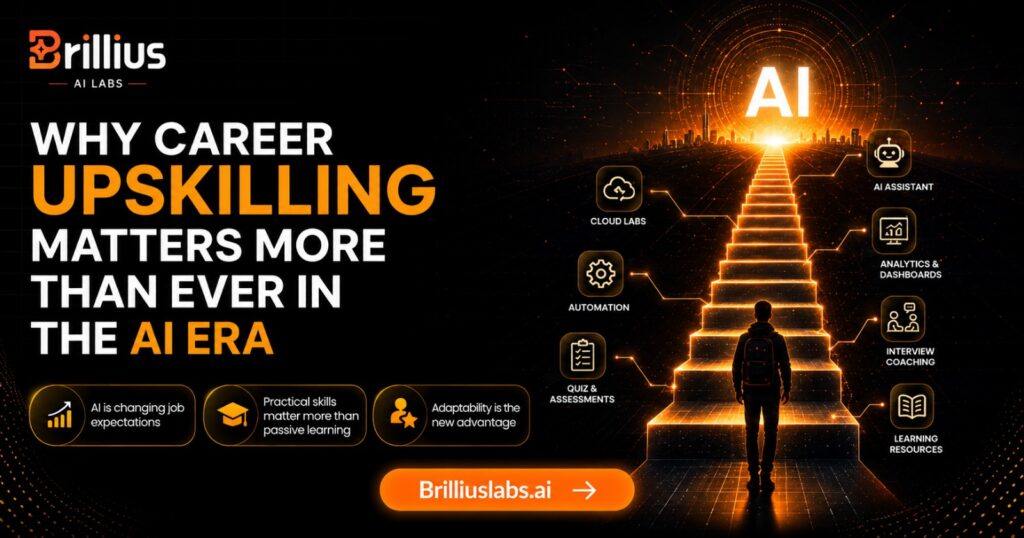
Career upskilling matters more than ever because AI is changing how work gets done.
Some tasks will be automated. Some roles will evolve. New opportunities will appear.
The professionals who keep learning will be better prepared for all of this.
The future of work will not belong only to AI. It will belong to professionals who know how to grow with AI.
At Brillius Technologies, we help professionals prepare for AI-era careers through practical and career-focused learning, supported by:
- AI Learning Path — structured guidance for career-focused skill growth.
- AI Assistant — instant support for learning doubts and concept clarity.
- AI Cloud Labs — hands-on practice in cloud-based environments.
- AI Interview Coach — interview preparation with AI-led feedback.
- AI Adaptive Quiz — knowledge checks that support better retention.
- AI Dashboard — progress tracking in one clear view.
- AI Resources — curated materials for continuous learning.