 Brillius
DevOps interviews are evolving.
Companies still expect engineers to understand Linux, cloud infrastructure, CI/CD, containers, Kubernetes, monitoring, and automation. However, they are also looking for candidates who understand how Artificial Intelligence can improve IT operations.
This is where AIOps—Artificial Intelligence for IT Operations—becomes important.
AIOps helps teams detect unusual system behavior, reduce alert noise, investigate incidents faster, identify root causes, and automate repetitive operational tasks.
Here is how you can prepare for an AI DevOps interview.
Strengthen Your DevOps Fundamentals
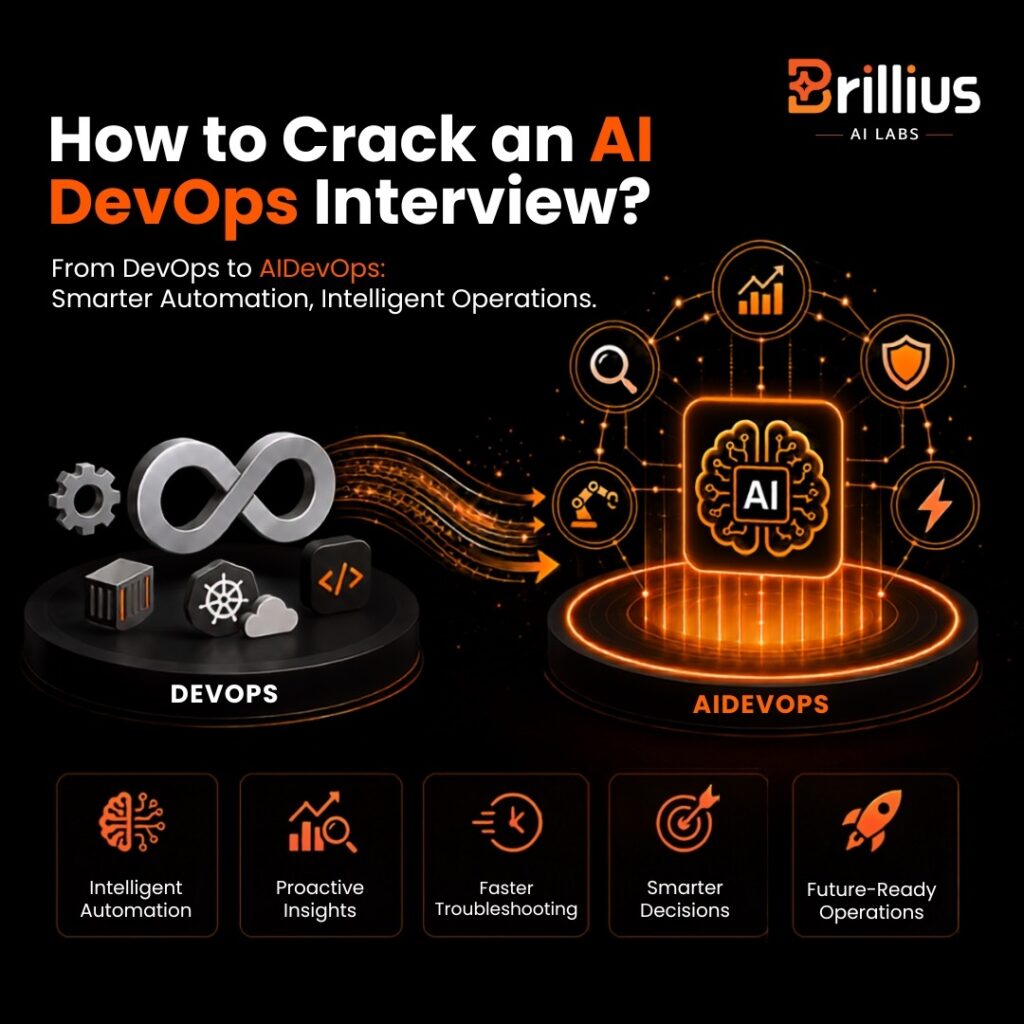
AI does not replace traditional DevOps skills. It builds on them.
Make sure you are comfortable with:
- Linux and networking
- Cloud infrastructure
- CI/CD pipelines
- Docker and Kubernetes
- Infrastructure as Code
- Monitoring and alerting
- Logs, metrics, and traces
- Incident response
An interviewer may ask:
A production service is experiencing high latency. How would you investigate it?
A strong answer should include checking recent deployments, service health, infrastructure usage, application metrics, logs, traces, database performance, and external dependencies.
You can then explain how AI-assisted tools may help detect anomalies, group related alerts, summarize logs, and suggest possible root causes.
This shows that you understand both traditional DevOps and AI-supported operations.
Understand What AIOps Solves
Avoid describing AIOps only as “AI for operations.” Explain the practical problems it solves.
AIOps can support:
- Anomaly detection
- Alert-noise reduction
- Incident correlation
- Root-cause analysis
- Predictive insights
- Automated remediation
- Faster troubleshooting
A simple interview answer could be:
“AIOps helps DevOps and SRE teams analyze operational data, identify unusual behavior, connect related alerts, and respond to incidents faster.”
Keep your explanation practical and connected to real engineering problems.
Learn Observability
Observability is one of the most important topics in an AI DevOps interview.
AIOps platforms depend on operational data such as:
- Logs
- Metrics
- Traces
- Events
A clear way to explain observability is:
“Monitoring tells us when something is wrong. Observability helps us understand why it is wrong.”
Metrics may show that latency has increased. Logs may reveal an application error. Traces may show where a request slowed down across multiple services.
AI-assisted tools use these signals to detect patterns and support root-cause analysis.
Prepare for Scenario-Based Questions
Interviewers may give you a production incident and ask how you would respond.
For example:
Multiple alerts started firing after a deployment. What would you do?
A structured answer could be:
- Identify the affected services and users.
- Review recent deployments and configuration changes.
- Check latency, error rate, traffic, CPU, and memory.
- Inspect logs and traces.
- Group related alerts and identify the common cause.
- Use AI-assisted tools to summarize signals or compare the incident with previous failures.
- Verify the evidence before rolling back, scaling, or changing the configuration.
The key is to show that AI supports your investigation. It does not replace engineering judgment.
Explain Concepts Clearly
Good communication is just as important as technical knowledge.
Practice giving short answers to questions such as:
- What is AIOps?
- What is anomaly detection?
- How does AI reduce alert fatigue?
- What is root-cause analysis?
- How can AI support incident response?
- How is AIOps different from traditional monitoring?
Avoid unnecessary buzzwords.
Instead of saying:
“AIOps enables ML-driven operational intelligence across distributed environments.”
Say:
“AIOps helps teams analyze large amounts of operational data and find problems faster.”
Clear answers are easier for interviewers to understand and remember.
Final Thoughts
Cracking an AI DevOps interview requires strong DevOps fundamentals, observability knowledge, practical troubleshooting skills, and an understanding of how AI can improve operations.
Focus on real use cases instead of memorizing definitions. Structure your answers clearly, explain your investigation process, and show that you can use AI responsibly.
At Brilliuslabs.ai, professionals can prepare for AI-era engineering through AI learning paths, cloud labs, adaptive quizzes, technical resources, and an AI Interview Coach.