 Brillius
AIOps cannot be learned effectively by only watching videos, attending webinars, or reading articles.
AIOps, or Artificial Intelligence for IT Operations, connects DevOps, observability, monitoring, automation, incident response, and AI-assisted decision-making. These are practical areas that require professionals to work with real tools, operational data, workflows, and problem-solving scenarios.
For DevOps engineers, this is especially important. Their daily work already includes managing deployments, monitoring applications, troubleshooting incidents, handling cloud infrastructure, and improving system reliability. AIOps builds on these existing skills by introducing AI, data analysis, intelligent automation, and faster operational insights.
That is why hands-on practice is essential for learning AIOps.
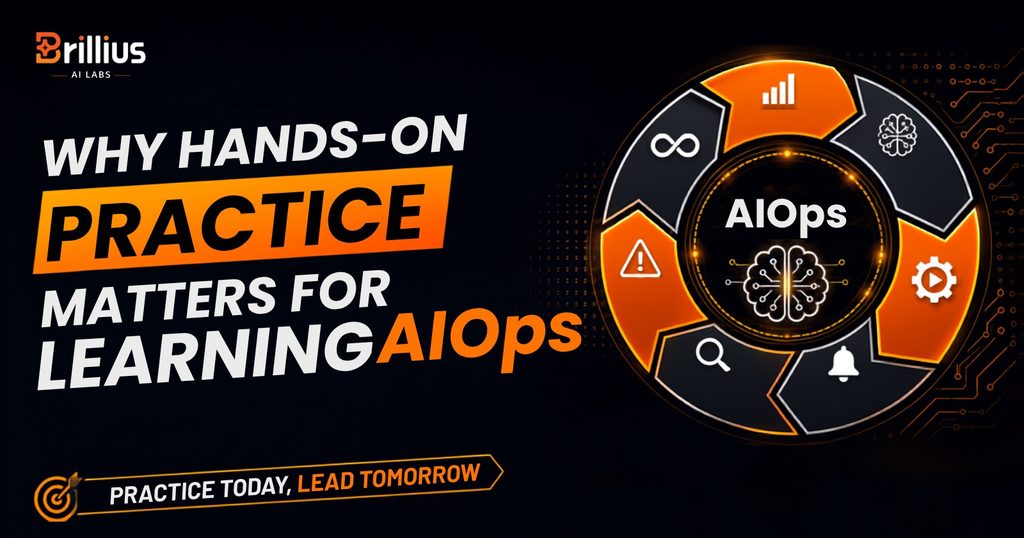
Watching Creates Awareness, but Practice Builds Skills
Learning content is valuable. It helps professionals understand what AIOps means, why organizations are adopting it, and how it can improve IT operations.
However, understanding a concept is different from applying it.
An engineer may watch a video about anomaly detection and understand its basic purpose. Real learning begins when they examine logs, metrics, or alerts and identify an unusual pattern.
Similarly, reading about observability can explain how logs, metrics, and traces work. But the concept becomes much clearer when engineers use dashboards, follow distributed traces, compare service metrics, and investigate an application issue.
Content helps professionals know the topic. Hands-on practice teaches them how to use that knowledge.
AIOps Requires Real Operational Thinking
AIOps is not simply about adding AI to IT systems. It is about using AI to improve how teams monitor, investigate, and manage technology operations.
Before engineers can use AI effectively, they must understand the operational problem.
During a production incident, teams may need to determine what changed, which service is affected, where latency increased, whether a recent deployment caused the issue, and which alerts are related.
AI can process large amounts of operational data and identify patterns faster. However, engineers still need to understand the system, validate the AI-generated insights, and choose the safest action.
Hands-on learning develops this operational thinking.
When learners work with logs, metrics, traces, dashboards, alerts, and incident scenarios, they begin to understand how systems behave under real conditions. They learn how to connect signals, investigate problems, identify possible causes, and make decisions based on evidence.
These abilities cannot be developed through theory alone.
Practice Builds Confidence for Real Work
Many professionals feel confident after completing a tutorial. However, when they try to apply the same concept independently, they often discover gaps in their understanding.
This is a normal part of learning.
Real skill develops when professionals attempt a task, encounter a problem, investigate it, correct their mistakes, and try again.
In AIOps, hands-on practice can help engineers understand areas such as observability, anomaly detection, alert correlation, root cause analysis, automated workflows, and incident response.
It also allows them to gain experience with tools and platforms such as Prometheus, Grafana, Jaeger, Kubernetes, and cloud-monitoring systems.
For example, an engineer might receive multiple alerts after a new deployment. Instead of reviewing every alert separately, they can inspect service metrics, compare logs, follow traces, and determine whether the alerts share a common cause. They can then use AI-assisted insights to support the investigation while validating the recommendation before acting.
Practical exercises like this help engineers move from “I know what AIOps is” to “I understand how AIOps can support real operations.”
Hands-On Learning Encourages Responsible AI Use
AI can provide useful recommendations, but those recommendations should not be followed blindly.
An AI system might identify a database as the possible cause of an incident. However, an engineer must still verify whether the database is actually responsible or whether a deployment configuration, network issue, or service dependency is creating the problem.
Hands-on practice teaches professionals to treat AI output as an operational clue rather than a final decision.
They learn to check the available evidence, understand the context, evaluate risks, select the safest action, and monitor the result.
This combination of AI assistance and human judgment is essential for using AIOps responsibly.
Practical Experience Improves Interview Performance
AIOps interview questions are not limited to definitions. Interviewers often use scenario-based questions to understand how candidates approach operational problems.
They may ask how a candidate would reduce alert noise, investigate high latency in a microservices system, use AI during incident response, or select the right observability data for an AIOps workflow.
Candidates who have only studied the theory may provide generic answers.
Candidates with hands-on experience can explain a clear investigation process. They can describe how they would review metrics, inspect logs, follow traces, identify service dependencies, correlate related alerts, validate AI-generated recommendations, and monitor the outcome.
This makes their answers more practical, structured, and credible.
A Simple Approach to Practising AIOps
Professionals do not need to begin with a complex production environment. They can start with guided labs and small operational scenarios.
The process can begin with observing system behaviour through dashboards, investigating a simulated incident, using operational data to identify the likely cause, taking a controlled action, and reviewing the result.
As learners repeat this process across different scenarios, they develop stronger technical judgment and greater confidence.
The objective is not simply to learn another monitoring tool. It is to understand how data, AI, automation, and human decision-making can work together to improve IT operations.
Final Thoughts
Hands-on practice matters for learning AIOps because AIOps is built around real operational challenges.
It involves understanding systems, detecting patterns, reducing alert noise, improving incident response, automating repetitive work, and using AI responsibly within engineering workflows.
Content can introduce these concepts, but practice builds the ability to apply them.
For DevOps engineers preparing to move towards AIOps, practical learning is one of the most effective ways to build confidence, strengthen operational skills, perform better in interviews, and prepare for AI-driven engineering roles.
At Brillius Technologies, we support practical and career-focused learning through structured AI learning paths, cloud-based labs, technical assistance, adaptive quizzes, interview preparation, progress tracking, and curated AIOps resources.
Start with the concepts, practise them in realistic scenarios, and develop the confidence to apply AIOps in real operations.