 Brillius
Modern applications run across cloud platforms, containers, Kubernetes clusters, databases, APIs, and microservices. When something fails, finding the root cause among thousands of logs, metrics, and alerts can be difficult.
This is where AIOps helps.
AIOps stands for Artificial Intelligence for IT Operations. It uses AI to analyze operational data, detect unusual behavior, reduce alert noise, and support faster incident response.
Why DevOps Engineers Need AIOps
Traditional DevOps automation follows predefined rules:
- If CPU usage is high, send an alert.
- If a container fails, restart it.
- If a test fails, stop the deployment.
These rules are useful for known problems. However, modern systems generate too much data for engineers to analyze manually during every incident.
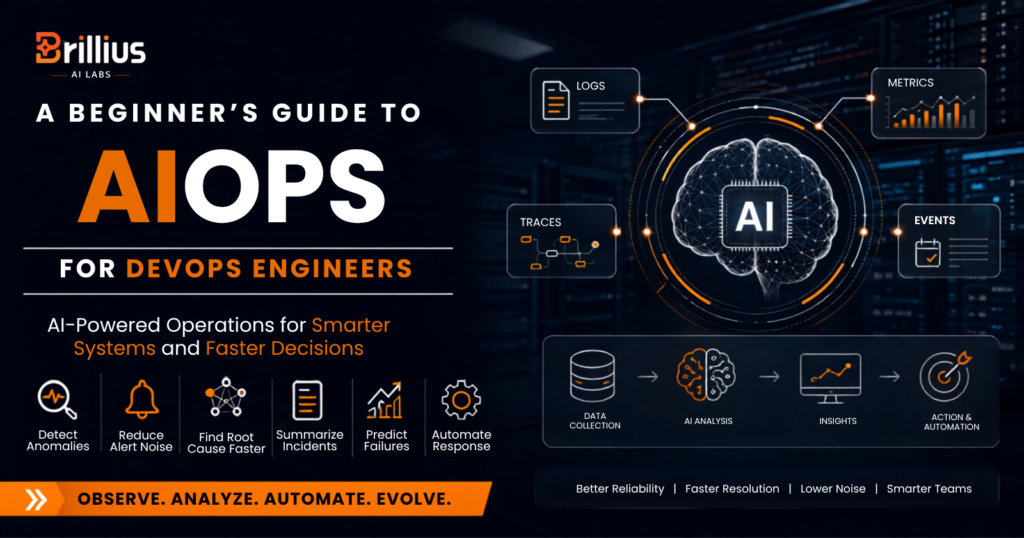
AIOps adds intelligence by helping teams:
- Detect unusual system behavior
- Group related alerts
- Identify possible root causes
- Summarize incidents
- Predict potential failures
- Automate selected recovery actions
AIOps does not replace DevOps engineers. It helps them investigate problems faster and make better decisions.
AIOps and Observability
AIOps depends on high-quality observability data:
- Logs explain what happened inside an application.
- Metrics show system performance over time.
- Traces track requests across different services.
- Events record deployments, failures, and configuration changes.
Monitoring tells engineers that something is wrong. Observability helps them understand why it happened. AIOps analyzes this information to identify patterns and recommend possible actions.
Common AIOps Use Cases
Anomaly detection: Identifies unexpected changes in traffic, latency, errors, or resource usage.
Alert reduction: Removes duplicate alerts and groups related notifications into one incident.
Root-cause analysis: Finds the service, deployment, or dependency most likely responsible for a failure.
Incident summarization: Provides a quick explanation of what happened and which systems were affected.
Predictive operations: Detects early warning signs before they become serious failures.
Automated remediation: Triggers approved actions such as restarting a service or scaling resources.
How to Start Learning AIOps
DevOps engineers do not need to become data scientists. They should focus on:
- Strengthening Linux, cloud, networking, Kubernetes, and CI/CD fundamentals.
- Learning logs, metrics, traces, dashboards, and alerts.
- Understanding anomaly detection, event correlation, and root-cause analysis.
- Practising with tools such as Prometheus, Grafana, and Jaeger.
- Applying AI to practical workflows such as log analysis and incident summarization.
Final Thoughts
AIOps is not replacing DevOps—it is helping DevOps evolve. Engineers who combine strong DevOps fundamentals with observability and AI-assisted operations will be better prepared for modern engineering roles.
At Brillius AI Labs, professionals can build these skills through structured AI learning paths, cloud labs, adaptive quizzes, technical assistance, interview coaching, progress tracking, and curated learning resources.
The future of DevOps will not only be automated. It will also be intelligent.